
Transition Meeting Best Practices
Earlier this week I wrote about the importance of having an effective transition between an outgoing and incoming leader in a volunteer organization. Today I want to dig into this idea a little deeper with a focus on what to do in a transition meeting between outgoing and incoming area and division Directors.
Area and division directors are leaders for a Toastmasters district, and a good transition from one year’s team to the next is one of the most valuable leadership moments in a Toastmasters year. Done well, it can set the next team up for immediate success instead of forcing them to figure it out from scratch.
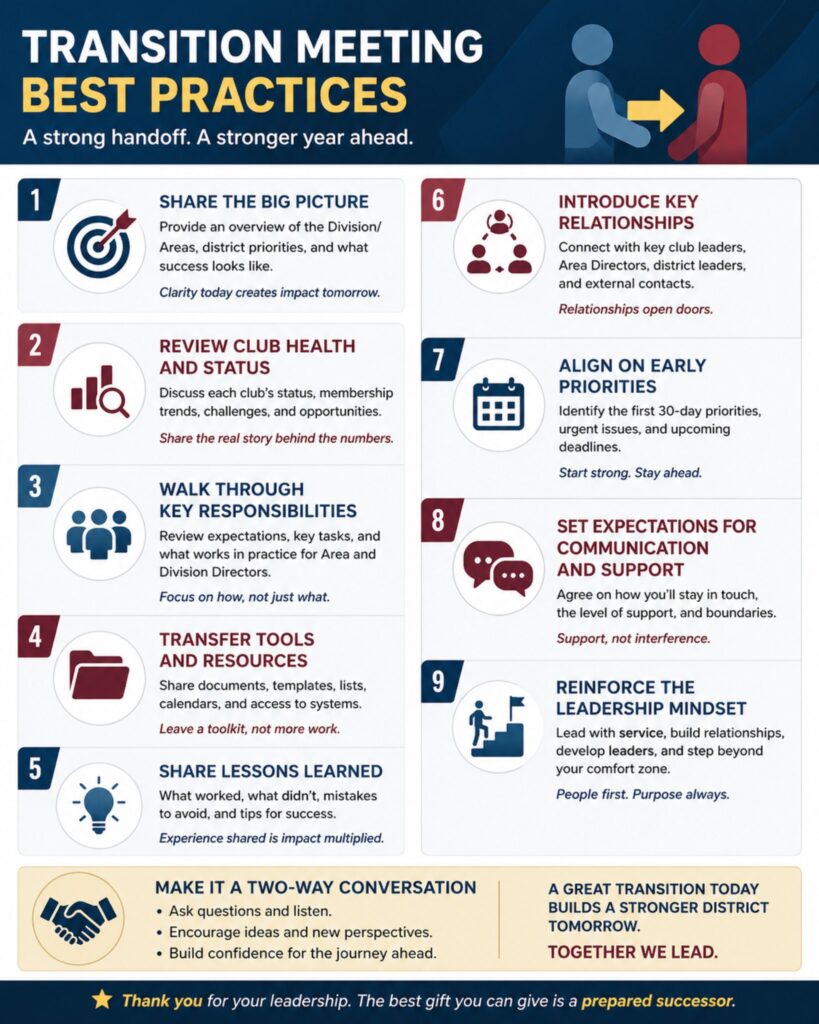
I queried ChatGPT, and it produced a list of things that an area or division director should cover in a leadership transition meeting. The list of things to cover includes:
- Share the Big Picture
- Review Club Health and Status
- Walk Through Key Responsibilities
- Transfer Tools and Resources
- Share Lessons Learned
- Introduce Key Relationships
- Align on Early Priorities
- Set Expectations for Communication and Support
- Reinforce the Leadership Mindset
1. Share the Big Picture
Outgoing leaders should help incoming leaders understand the landscape they are stepping into. This includes giving the incoming area/division director a picture of what the area/division looks like, such as which clubs belong to the area/division, which clubs are doing well, and which clubs need extra support.
An overview of what success looks like for the area/division also helps. This can include a review of the goals and growth targets for the area/division. This can include a discussion of the distinguished club, area, and division programs, but goals for an area/division don’t have to be limited to these programs.
Sharing the big picture helps the new leader start with clarity instead of confusion.
2. Review Club Health and Status
One of the most critical parts of the transition is sharing with the new leader the health and status of the clubs in the area/division. When the new leader knows which clubs are strong, struggling, and rebuilding, they will know better which clubs need extra support.
Share with the new leader which clubs need immediate attention. Also explain why these clubs need help. For example, there could be a club with low membership or a club that has leadership gaps and needs help equipping its members to lead the club effectively. There could also be new clubs in the area or division that may need extra support as the members and officers learn how to run the club.
Also share potential opportunities within the area or division. This can include areas with potential for growth, new community clubs leads, and corporate club leads.
Give honest, candid insights. Not just what’s on paper, but what’s really happening.
3. Walk Through Key Responsibilities
Incoming leaders need clarity on what to actually do in their new role. This is especially important when the new leader is serving as an area or division director for the first time.
For an area director, share with them how to conduct effective club visits. Also explain how they submit their club visit reports and the importance of submitting those reports on time. Share your experiences and what you did as area director. Also share with them the importance of running area council meetings and running an effective area speech contest. Also stress the value of supporting the club officers in the area.
For a division director, explain the importance of supporting their team of area directors. Encourage them to meet with each of their area directors one-on-one at the start of their leadership term. Also stress the value of running division council meetings. And explain the importance of running a division speech contest, as well as sharing your experiences in running such an event.
Share what worked in practice, not just what the District Leadership Handbook says.
4. Transfer Tools and Resources
Don’t let valuable systems disappear with the outgoing leader. If you used any tools during your term, be sure to pass those tools on to your successor. This includes district leadership manuals from the Toastmasters International website as well as any software and documents that helped you lead your area or division successfully.
5. Share Lessons Learned
One of the most impactful parts of the transition meeting is sharing the lessons you learned during your year as area or division director. Share with your successor what worked well this year, what didn’t work and why, mistakes to avoid, and best practices.
For best practices, share tips for doing effective club visits and tips for how to run an area or division speech contest. Also share any tips you have for supporting struggling clubs, motivating teams, and tips for managing time and priorities.
Be real. This is mentorship, not a highlight reel.
6. Introduce Key Relationships
Something you can do to help your successor is to share key relationships with them. This means connecting your successor with the members in your area or division. At a minimum this can mean giving them the contact list for the club officers in your area or division so that the new leader has the contact info for the clubs in his or her area/division.
To go beyond the minimum, you can share who the key influencers are in each club and/or who the best person to contact is in each club. This can initiate the building of relationships between the clubs and the new area or division director.
Sharing relationships can also include introducing the new leader to people outside his or her area/division that they can go to for support, such as current or past district leaders.
7. Align on Early Priorities
Knowing where to start is often a challenge for a new area or division director. This is where the transition meeting can help the incoming leader hit the ground running.
In your transition meeting, share with the new leader what should be done in the first 30 days. For example, one thing a new leader needs to do is to initiate contact with the clubs in the area and introduce himself or herself to those clubs.
Other early priorities include identifying immediate risks in the area/division and any clubs in need of urgent support. Also identify upcoming deadlines, like club visit report submission deadlines, club officer list submission deadlines, and club officer training deadlines. These can be deadlines that apply to the area/division director, and deadlines that the area/division director needs to communicate to the clubs in the area/division.
Aligning on early priorities creates momentum from day one.
8. Set Expectations for Communication and Support
A transition from the outgoing leadership team to the incoming leadership team doesn’t end with one meeting. It is important during the transition meeting to identify how the outgoing leader can support the incoming leader moving forward. This can be as simple as establishing communication lines, such as offering to be available via email during the year if the new leader has a question or needs help during the year.
Clarify boundaries (advisor vs. decision-maker). For example, if you do agree to be a resource the new leader can call on, establish what that relationship will look like. You could plan for once-a-month mentoring sessions or just offer to be available during the year to answer questions.
9. Reinforce the Leadership Mindset
End the transition meeting on the right tone. Remind the new area or division director that his or her role is about serving clubs and developing leaders. Also stress the importance of focusing on relationships, not just metrics. The Distinguished Club Program can identity strong clubs and clubs in need of support, but effective leadership is more than just measuring club performance.
Conclusion
Great leaders work to develop other leaders, and one of the ways we can do this is by supporting the new leaders that take over from us when our term as an officer ends. I encourage you to use the ideas from this article to help you run an effective transition meetings.
This article was about the transition for Toastmasters area and division directors, but the ideas can apply to other organizations as well. I encourage you to expand beyond the ideas in this article and to add your own ideas, insights, and experience to effectively equip your successor to lead effectively in his or hew new role.