
The Club Coach Journey: Building a Stronger Club Together
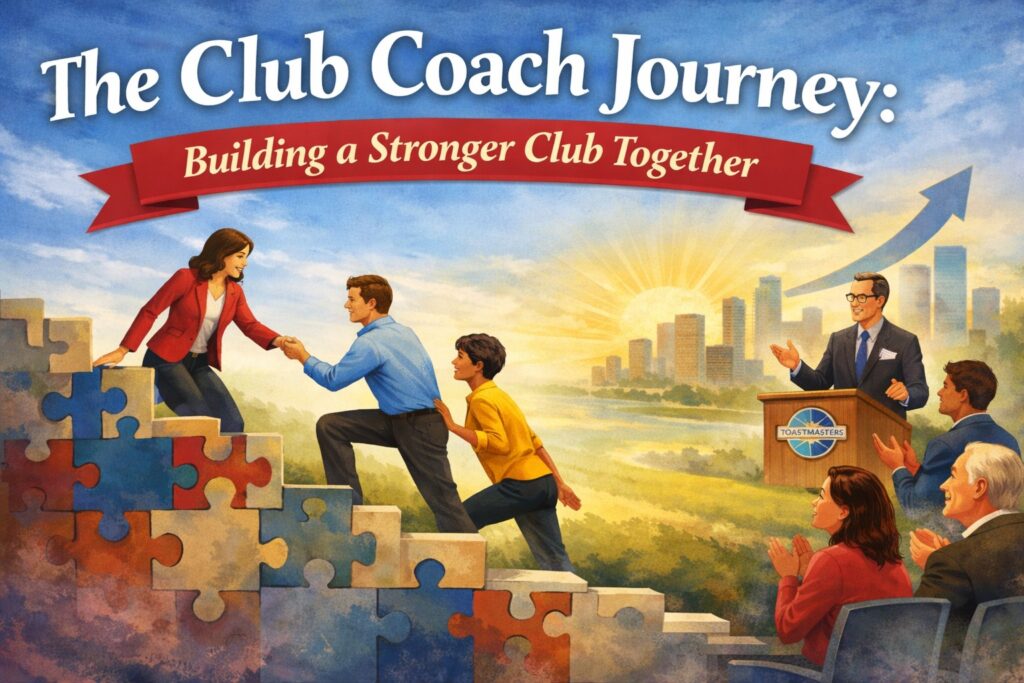
I have embarked on a new journey as the coach for a Toastmasters club. My goal on this journey is to help the club I am coaching to reengage its members, to help them build up their membership base, and to help the club to achieve its goals on the Toastmasters Distinguished Club Program.
To help me with this mission, I asked ChatGPT to give me an outline for a speech I can present to this club to explain what a club coach is and what the purpose of the club coach program is. Based on the feedback from this AI tool, I came up with the following outline for my speech:
- My journey as a Toastmaster.
- What a Club Coach is.
- Why clubs receive coaches.
- The success vision.
- How members can help the coaching process succeed.
My Journey as a Toastmaster
My journey as a Toastmaster is relevant to my role as club coach. It gives me credibility as someone who can provide support to a Toastmasters club. So where did I start in Toastmasters?
My Toastmasters journey began when I joined the Sundowners Toastmasters club in Spruce Grove, Alberta, Canada in November 2010. I started out with not a lot of interest or confidence in giving speeches. In fact, it took me three years to give my first five speeches as a Toastmaster.
But then everything changed in May and June of 2013 when I moved into my first leadership roles as a Toastmaster. I was elected as secretary of Sundowners Toastmasters in May 2013. This led me to attend a club officer training event in June 2013. At this training event, I heard they were recruiting area governors, and I volunteered to be an area governor.
Serving as an area governor changed my life. I went from someone addicted to video games to being a leader for my Toastmasters district. I was visiting other clubs and organizing speech contests. I was also giving speeches at other clubs.
Ever since my leadership journey was triggered by attending that training event in June 2013, I have been passionate about Toastmasters. I have now served as area governor (now called area director) twice, and as division director three times. I am also currently serving as Club Growth Director for District 28 Toastmasters, and I aspire to serve as Program Quality Director, and then as District Director.
Long story short, this positions me as a knowledgeable Toastmaster who can work with others to help them support and grow their Toastmasters club. And this is what I want to do in my new role as club coach.
What a Club Coach Is
A club coach is an experienced Toastmaster assigned by the district to support a club. Someone who supports the club, but does not take over the club.
Instead, the coach works with the club officers and members to:
- Strengthen meetings
- Improve the member experience
- Help the club grow
Think of a Club Coach like a guide or facilitator. The club members already have the talent and potential to revitalize their club. The coach simply helps the club unlock that potential.
Ultimately, the club officers work with the club coach, but the coach does not run the club. The coach offers ideas, insights, and feedback, which the officers use to strengthen and rebuild their club.
Why Clubs Receive Coaches
A Toastmasters district assigns a club coach when a club falls below the healthy membership level. As defined by Toastmasters International, this is when a club falls to 12 members or fewer.
With lower numbers, there are fewer members to take on meeting roles and experienced members may feel the burden of having to take on more senior roles in a meeting more often. Members may also find that they have to take on more than one role in the same meeting. If this issue is not addressed, it could lead to burnout or reduced enjoyment for the remaining members in the club.
Appointing a coach doesn’t mean the club has failed. In fact, it means the district believes the club has strong potential and wants to support its success.
When a coach starts working with a club, he or she can help identify things like:
- How meetings can become more engaging
- How to attract and welcome new members
- How to build stronger systems within the club
The goal is not criticism. The goal is support and improvement.
The Success Vision
Ultimately, the purpose of the Club Coach role is to help the club achieve several things. Firstly, the goal of a coach is to grow the club’s membership to a healthy level. Secondly, the goal is to create a club where members are active, engaged, and happy to attend meetings. Thirdly, the goal is to help the club achieve Distinguished Club status through the Toastmasters Distinguished Club Program.
But the real goal goes beyond points and numbers. The real goal is to create a club where:
- Members grow as communicators and leaders
- Guests feel welcomed and inspired
- Meetings are enjoyable and meaningful
As Ralph Smedley, the founder of Toastmasters International, said: We learn best in moments of enjoyment.
How Members Can Help the Coaching Process Succeed
A club coach cannot succeed alone. The success of this club depends on all of the club members working together.
How can members of the club help? By giving speeches, by taking on meeting roles, by inviting guests, by supporting fellow members, and by sharing ideas to improve the club.
When members participate and contribute, the club becomes stronger. The coach simply helps guide the process.
Conclusion
The Club Coach program is a powerful leadership opportunity. It allows the coach to develop mentoring, coaching, and leadership skills while supporting a group of dedicated members as they rebuild and strengthen their Toastmasters club.
For the club members, it is an opportunity to breathe new life into their club. With the support of a coach and the commitment of the members, the club can rediscover its energy, strengthen its culture, and create an environment where people grow as communicators and leaders.
When everyone works together with a shared vision, the club coach journey becomes more than a recovery effort. It becomes a story of renewal, collaboration, and success.
Excellent article. Clear, succinct, well-organized and educational.